Margin Notes

TRY THIS TOMORROW: CHOOSING FLUENCY EXCERPTS AHEAD OF READING A COMPLEX TEXT

Feb
26

Texts used for fluency teaching and practice should be connected to reading students are actually going to engage in. One of the most effective ways to do this is to select a short, purposeful excerpt from a complex text before students read it in full. When used this way, fluency practice supports access, comprehension, and confidence going into the larger reading task.

A strong fluency excerpt gives students more than a chance to reread. It introduces essential vocabulary, builds background knowledge, and offers an early glimpse into the ideas, tone, and language of the text they are about to encounter. Through repeated reading, students begin to make sense of complex sentences and unfamiliar concepts before they face them at scale.

This kind of fluency work helps students feel oriented rather than overwhelmed. By the time they begin the full text, they have already heard the language, practiced making meaning, and developed a sense of what the reading will ask of them. In this way, fluency practice becomes a form of preparation that sets students up for success across the entire reading experience.

Here is an example using  Climbing Cringe Mountain With Gen Z from the NYT Learning Network.

Fluency Excerpt:

The phrase cringe mountain came from Erica Mallett, 34, a creator consultant based in Sydney, Australia, who coined it in 2023. Ms. Mallett spent years in the public eye, first as part of the hip-hop duo Coda Conduct and later as a host of a national breakfast show on the radio station Triple J. The role put her in front of a huge audience almost overnight, and she was bombarded with texts from listeners telling her she was “so cringe.”

This idea of stumbling publicly, enduring judgment and finding resilience in the process is not new. What’s new is the language. The phrase “cringe” is distinctly of the internet age, born of comment sections and meme culture to describe acute awkwardness or social embarrassment.

At first, Ms. Mallett tried to shrink herself to avoid criticism, but it only dulled her personality and stifled her creativity. She eventually reframed the word, deciding that being cringe was actually proof she was experimenting and taking risks. To her, “climbing cringe mountain” meant growth.

Why this excerpt:

This excerpt works for fluency practice because it prepares students for the larger text they are about to read. It introduces the term “cringe mountain” and reframes it from public embarrassment to personal growth, giving students essential background knowledge needed to understand both the article’s title and its central idea. Vocabulary such as “meme culture” and “acute awkwardness” supports students as they engage with the article’s exploration of public judgment, embarrassment, experimentation, and risk taking. By working through these concepts in the excerpt, students are better positioned to make sense of the full text as they read. Additionally, the explanatory, layered sentences offer opportunities for students to practice phrasing and pacing while making sense of complex meaning.


BOOK RECOMMENDATION: THE TROUBLE WITH HEROES BY KATE MESSNER

Feb
24

“Climbing isn’t about
reaching the top.
It’s about pushing past limits
of what you thought you could do.
If you never fall, never fail, you’re not growing,
you know?”

In The Trouble With Heroes, readers meet Finn Connelly, a thirteen-year-old still dealing with his father’s death and the anger that has built up around it. After falling behind on schoolwork and knocking over the gravestone of a well-known local climber, Finn is given an unusual option: spend the summer climbing all 46 Adirondack High Peaks with the climber’s dog instead of facing prosecution.

What starts as a punishment becomes a routine that pushes him to face his grief, his frustration, and the silence he’s been carrying. The climbs, the poetry assignments he owes, and the steady support of the people around him help him take small steps toward understanding himself again.

The book addresses serious topics including parental loss, 9/11, alcoholism, and PTSD, but it handles them with clarity and care. Finn starts the story shut down and angry, and the hikes give him a structure he cannot avoid. He calls the adults who join him “babysitters,” but each person has a connection to his father or to the woman whose grave he knocked over. They walk beside him, offer steady presence, and give him room to feel what he has been pushing away. Over time, readers see him shift from resistance to small moments of honesty, then to reflection, and finally to the early stages of healing. Each character helps him take one more step forward, both on the trail and within himself.

This is a great recommendation, particularly in classrooms where students are exploring grief, identity, accountability, or resilience. The accessible verse style makes it engaging for a wide range of readers. It lends itself well to ELA or social-emotional learning discussions about how communities support healing and what it means to redefine heroism in personal terms. Grab a tissue before you begin but, important spoiler, the dog survives the entire book!

TRY THIS TOMORROW: REACT TO AND CRITIQUE A TEXT

Feb
19

This lesson comes from The Heart of Fiction by Kate Roberts. In this chapter, Roberts points out that students often feel like they can’t question the texts presented in classrooms. Texts can become “off limits,” and students learn to accept the author’s choices without examining them. The goal of this lesson is to show students that they can critique a text and that doing so helps them become stronger, more independent readers.

Below is how you can use her idea tomorrow with Grades 6–12.

How to Teach It

  1. Start with a quick media clip

Show a short clip of teenagers from a TV show. Then ask:
“Is this actually what it’s like to be a teenager?”

They’ll immediately identify what feels inaccurate. This sets up the idea that representation can be off, even when the creators try.

  1. Connect that idea to books

Tell students they can apply the same thinking to the books they’re reading. Authors don’t always get characters, situations, or perspectives right. Students are allowed to notice that.

  1. Give students specific critique questions

Share a short list such as:

  • Does this feel realistic based on my experience?
  • What seems unrealistic or off?
  • Whose perspective is missing?
  • Is this how problems get solved in real life?
  • What would I change?

These mirror the questions in the lesson and keep the task focused.

  1. Have them answer the questions

Students can work individually or in groups. If students are reading different books, have them respond on their own and then compare patterns.

  1. Make a quick class graph

On a scale of 1–5, have each student rate how accurately their book captures real life. Post the results. It’s fast, visual, and helps spark discussion.

  1. Discuss what makes a book feel “real” or not

Talk as a class or in small groups about what authors do that helps, or hurts, believability. This can lead to conversations about representation, stereotypes, missing voices, or overly convenient endings.

Students already critique music, shows, and social media. This lesson taps into skills they already use naturally and attaches them to classroom reading. It also gives them a way to talk about books that goes beyond “I liked it” or “It was boring.”

Source

Roberts, Kate. The Heart of Fiction. Chapter 11: “React to and Critique the Text.”


BOOK RECOMMENDATION: IMMORTAL CONSEQUENCES BY I.V. MARIE

Feb
17

Immortal Consequences by I.V. Marie is a young adult fantasy set at Blackwood Academy, a boarding school that exists between life and death. The story follows six students who have already died and are selected to compete against each other in the Decennial, an annual competition that determines who earns power and the chance to move beyond the academy. As the trials unfold, the novel explores how each character’s past and present choices shape their approach to survival, loyalty, and sacrifice.

Written from all six perspectives, the writing allows for a slow build in understanding relationships, their history, and the unreliable nature of each voice. Like most fantasy series, this intro book spends the time needed to understand the world and secure readers in the complexities of another realm.

The book touches on so many themes with topics from teen romance and friendships to rivalries to past trauma and how it presents in current decision-making.

Immortal Consequences is a perfect recommendation for readers who enjoy fantasy and are ready to engage with complex character relationships and multiple points of view. Book 2 of the series, titled Ruinous Ends, is set to release in 2026 so stay tuned for more drama at Blackwood Academy.


FROM RESEARCH TO THE CLASSROOM: SENTENCE COMPREHENSION

Feb
12

“A Closer Look at Close Reading: Three Under-the-Radar Skills Needed to Comprehend Sentences” by Heidi Anne Mesmer and M.M. Rose-McCully (The Reading Teacher, 2017)

“Close reading requires unpacking the implicit relationships within and across sentences. However, beyond the close-reading rage, students need to understand the ways writers cleverly use structures to add interest, description, and parsimony to their writing.”

Summary

In this article, Mesmer and Rose-McCully, highlight the impact of sentence-level comprehension on overall reading comprehension. They focus on three specific sentence constructions that can be taught explicitly to support students’ understanding of text.

  1. Anaphora is when one word or group of words replaces another within a sentence or across sentences. Pronouns are the simplest kinds of anaphoric relationships. The word(s) being replaced in anaphoric relationships are called antecedents because they come before the replacing words. Authors use anaphora for description, variety, and parsimony in their writing.
  2. Connectives explicitly link one clause to another (for example and, but, that, and which) or connect two adjacent sentences (such as however or thus). Because different connectives suggest different relationships, they signal to the reader that they must make a text-based inference.
  3. Appositives are nouns, noun phrases, or noun clauses that are set off by commas and immediately follows a noun. An appositive renames the noun and provides more information about it.


Takeaways For the Classroom

The authors provide a variety of practical strategies for explicitly teaching and practicing each structure:

Anaphora

  • Model and practice using highlighters to identify pronoun replacements and colour-code their relationships.
  • Create Mad-Lib style games for students to fill in nouns or pronouns.
  • Provide students with sentences containing pronoun replacements and have them work in small groups to creative descriptive noun replacements for the pronouns while maintaining the anaphoric relationships.

Connectives

  • Create cloze activities by giving students a portion of text they will be reading with the connectives removed. Ask them to select connectives from a bank of options based on the context of the sentence.
  • Provide students with sentence parts and have them work in partnerships to join them with connectives.
  • Practice sentence combining by having students use connectives to combine shorter sentences into a longer complex sentence.

Appositives

  • Provide students with sentences containing lengthy or multiple appositives. Ask them to cross out the appositives and see if they can make meaning from the sentence without it.
  • Invite students to create a list of nouns they can use to describe themselves and then write a descriptive paragraph using appositive phrases.
  • Create appositive poetry by asking students to pick an object and write a four-line poem about it using appositive phrases.

Conclusion

“…we have come to see connectives, appositives, and anaphora as being crucial to sophisticated reading and writing in the upper grades and beyond…students must use these structures in their own writing, transfer their knowledge to authentic materials, and begin to spot the clever ways that writers use these tools.”

THE RIGHT CALL BY TOMMY GREENWALD

Feb
10

In The Right Call, Greenwall returns to Walthorne, the same community as his previous novels, Dinged, Rivals and Game Changer. This time, the plot follows Cal Klondike, a talented pitcher attracting attention from colleges and professional scouts. Of course, this kind of attention brings pressure to not only Cal, but his family and the coaching staff. Ultimately, this future path is all challenged by one call, one night, one decision. The story opens with a police scanner transcript that details an altercation leaving one man unresponsive. Readers are then taken back in time to learn how we got there and, more importantly, how to move forward.
One of the book’s greatest strengths is its multiformat structure. The narrative unfolds through texts, emails, news articles, and transcripts, requiring readers to actively piece together the story. This approach mirrors how adolescents experience information today. Each format provides another layer of the story that shapes into a relatable and all too common reality for many young players dealing with the treatment of umpires and other youth sports staff.

As always, a special shoutout is needed for the author’s note where Greenwald links to current articles that inspired this story. The ability to pair engaging storytelling with timely, real-world issues is a reason this book stands out. The Right Call is recommended for middle and high school readers, especially for discussions around decision-making, pressure, and ethics in competitive environments.

TRY THIS TOMORROW: CURRENT EVENTS CONVERSATIONS ON THE NEW YORK TIMES LEARNING NETWORK

Feb
05

Every Thursday, the New York Times Learning Network releases a new Current Events Conversation where they publish comments from teenagers who replied to one of the daily writing prompts. Students from anywhere in the world can join the conversation. The editors also highlight schools that took part, which means a class might see a public shout out to their school while taking part in a global dialogue.

After reading the article to build background on the topic, this feature offers several meaningful opportunities, including:

  • reading with the purpose of taking a stand on a topic
  • engaging with an authentic audience beyond the classroom
  • gaining new perspectives that broaden and deepen their thinking
  • participating in conversations with teens from many places and backgrounds

There are also many low-pressure ways to participate, especially helpful for students who have not yet discovered what they want to say on a topic. Students can:

  • choose a comment that most closely aligns with their thinking and explain how or why
  • choose a comment that changed or expanded their thinking and reflect on what caused the shift
  • join the discussion later, once they feel ready to contribute a fully formed idea

For those who do submit a comment, the editors revise and condense student writing before publication, creating a unique opportunity for feedback. Students can compare their original comment with the edited version to notice changes in clarity, tone, concision, or organization. They can reflect on which revisions strengthened their writing and which ones surprised them.

The series also offers powerful curriculum connections. It is an easy way to show the three strands of the NB Curriculum Framework working together.

  • They read for meaning, nuance, and perspective.
  • They represent their own ideas by crafting a thoughtful written comment.
  • Students interact with peers from around the world through written dialogue.

This serves to show students the interconnected nature of the curriculum strands.

Because this is a long running feature, teachers have countless mentor texts ready to use. These models can help students notice what makes a comment effective. They also pair beautifully with a Must and Might chart. Teachers can gather a handful of comments and invite students to identify writing moves that appear in every example and moves that appear only sometimes. This work supports drafting, revising, and building genre awareness. You can explore a fuller explanation of Must and Might charts here.

Try this tomorrow and let students explore what it feels like to join a community of young thinkers who are learning from one another.


SNOOP BY GORDON KORMAN

Feb
03

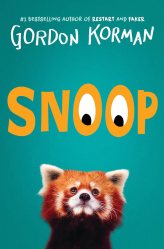
A small moment of distraction has big consequences for Carter. On a ski trip with his father and brother, he pulls out the phone he was supposed to leave at home and misses the moment his brother loses control on the hill and crashes into him. The crash leaves Carter with two broken legs.

Stuck at home for weeks with both legs in casts, Carter is confined to a wheelchair and attending school online. He is physically cut off from his classmates and psychologically struggling with the feeling that life is moving on without him. What starts as harmless curiosity, checking live police camera feeds around his town, slowly turns into something more complicated. Before he knows it, Carter is watching classmates who don’t know they are being watched, noticing strange patterns no one else seems to see, and getting pulled into a situation that feels increasingly dangerous. The question is not just what Carter is seeing anymore, but whether he should be seeing it at all.

Carter’s internal struggle between doing the right thing and avoiding trouble, between telling the truth and protecting himself, will feel painfully familiar to many readers. Watching him navigate those choices gives readers a window into the kinds of decisions many middle schoolers face, or soon will, and invites them to think through the consequences.

What Gordon Korman does so brilliantly in Snoop is take mature themes such as privacy, surveillance, trust, moral responsibility, and isolation, and make them accessible and safe for middle school readers without ever watering them down. Korman is known for creating stories that kids want to read, while quietly inviting them to think about complicated questions. In Snoop, those questions include: Who can you trust? What do you owe other people? When does curiosity cross a line? The story is fast paced and gripping, but those questions stay may stay with the reader long after the final page.

Overall, Snoop is a compelling middle grade read that balances tension, character, and thoughtful reflection in equal measure that one that I highly recommend.