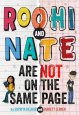
ROOHI AND NATE ARE NOT ON THE SAME PAGE BY SUPRIYA KELKAR AND JARRETT LERNER
 “It was like the magic of a library, the way the stories there made you feel connected to characters you’ve never met…Maybe that magic worked in real life, too, letting you see the layers underneath real-life people you thought were one-dimensional. It was so unexpected. Like how you weren’t supposed to judge a book by its cover, something I was guilty of doing.” (103)
This book is a love letter to librarians. It is a letter of hope to middle school students who are figuring out who they are in the mix of their parents, siblings, friends and classmates. In ROOHI AND NATE ARE NOT ON THE SAME PAGE, readers meet over-achiever Roohi, who spends her time in the library to avoid the jealousy of seeing her friends move on without her, and Nate, who spends his time skateboarding and trying to dodge the comparisons to his genius older brother. This unlikely pair find themselves joining a lunch book club and connecting through the pages of a fictional text. And, yes, the book is about Roohi and Nate; but, it’s really about how libraries and books are a place for finding yourself, interpreting the world around you and (can be) a refuge from everyday pressures.
The storytelling uses dual first-person narration. Roohi’s chapters are written by Kelkar, while Nate’s are written and illustrated by Lerner. The book is filled with doodles and sketches that reflect each character’s specific style. Beyond the unlikely friends trope, the plot explores student activism. When the group learns that their librarian’s job is being cut due to budget constraints, they take action, showing how young people can use their voices to advocate for change. I also appreciated that the ending doesn’t tie everything up neatly, which reflects the complexities of real life.
Roohi’s storyline will appeal to avid readers who are always reaching for their next book, while Nate’s perspective is perfect for students who haven’t yet found themselves in reading. This book would also make an excellent read-aloud, opening up conversations about books and libraries, but also about the value of different voices, the experiences students bring with them, and what it means to shape your own story.